




Home/Education/Diamond Buying Guide/ The 4Cs of Diamonds : Our Guide
The 4Cs of Diamonds:
Our Guide
When buying a diamond there are four essential elements to consider, Cut, Colour, Clarity and Carat. These are known as the 4 Cs.
Although each of these characteristics are significant and play an essential role in contributing towards a diamonds overall value and beauty, the Cut is considered to be the most important.
Read on to find out why each ‘C’ is important when choosing a diamond.
Diamond Clarity
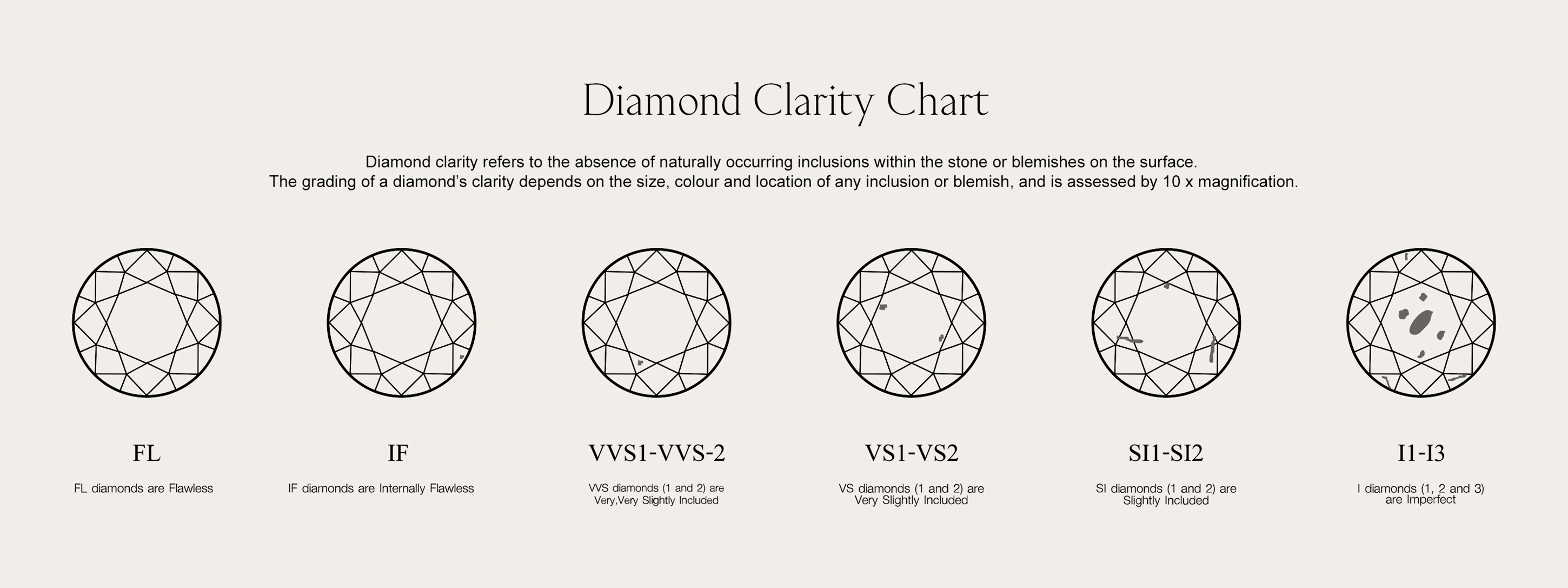
Diamond clarity refers to the stone’s purity in terms of internal and external blemishes and inclusions (imperfections) and is graded qualitatively by gemmologists, on a sliding scale, using 10x magnification. Blemishes and inclusions occur naturally as the diamond grows deep within the earth. The fewer the inclusions, the higher the grade.
Clarity is assessed by considering the size, quantity, and location of imperfections within the stone. While it is extremely rare for a diamond to be graded as flawless (FL) or Internally Flawless (IF), diamonds classified as VVS1 or VVS2 (Very, Very Slightly Included) are virtually flawless, and those classed as VS1 (Very Slightly Included) or VS2 have excellent clarity. Inclusions in diamonds graded within the SI category or better are impossible to see with the naked eye. It is important to recognise that once set into jewellery, even some of the more obvious inclusions become invisible to the naked eye.
Types of Inclusions
Inclusions within diamonds are a good indicator that the stone is an actual diamond as opposed to a simulant. They occur during the diamonds growing process, whether that be within a laboratory or more traditionally within the earth.
Inclusions will usually be less visible in a brilliant cut style stone, such as a princess cut and therefore you could consider a lower clarity grading, whereas in a step cut, such as an Emerald cut, inclusions are generally far more visible to the naked eye.
These characteristics can be internal inclusions or external blemishes.
Common Types of Internal Inclusion:
Crystals: can be colourless or coloured depending on the included mineral. A clear crystal could be another small diamond, a black crystal, typically a piece of carbon. Coloured crystals being more obvious are less desirable.
Feathers: a cleav which looks like a feather.
Butterflies: also, cleavage cracks, these have the appearance of butterfly wings.
Pinpoints: very small white or black crystals embedded within the diamond.
Cloud: small groups of tiny transparent bubbles or inclusions which collectively give a clouded appearance.
Graining: similar to graining is wood, these are lines within the stone which are usually caused by irregular crystal growth.
Growth lines: An internal jagged line.
Knot: a transparent or white crystal located at the surface of a polished diamond.
Needles: long fine inclusions which are usually colourless or white.
Twinning whisps: indicate when a diamond stops and then restarts growing, sometimes in a different direction. They are characterised by pinpoints, clouds or crystals.
Common Types of External Blemish:
Cavities: holes or openings on the stones surface typically occurring during the polishing process. Smaller cavities are known as pits.
Polishing lines: close parallel lines on the surface of a facet caused during the manufacturing process, usually due to poor polishing or polishing in the wrong direction.
Burn marks: again, a result of poor polishing.
Indented natural: falling beneath the diamonds surface, it is usually found on the girdle, this is a part of rough diamond which has been left unpolished.
Scratches & Abrasions: normally shallow & frequently caused by diamonds rubbing against one another.
Chips & nicks: often on the girdle but can be found on facet edges and commonly caused by hard knocks.
Twinning lines: Single or parallel lines caused during the natural growth process which are highlighted when a stone is polished.


