

Home/Education/Diamond Buying Guide/ The 4Cs of Diamonds : Our Guide
The 4Cs of Diamonds:
Our Guide
When buying a diamond there are four essential elements to consider, Cut, Colour, Clarity and Carat. These are known as the 4 Cs.
Although each of these characteristics are significant and play an essential role in contributing towards a diamonds overall value and beauty, the Cut is considered to be the most important.
Read on to find out why each ‘C’ is important when choosing a diamond.
Diamond Cut
Not to be confused with shape, a diamond’s cut refers to how well the diamond’s facets play with light, and the balance of proportions the diamond cutter produces within the stone. The better the arrangement and alignment of facets impacts the resulting cut and hence, the more beautiful the diamond. An Excellent cut grade means the stone has optimum brilliance, sparkle and fire and therefore a great deal of emphasis is placed upon a stone’s cut and the skilful craftsmanship the diamond cutter is able to achieve.
However, only a round brilliant cut diamond is given a cut grade. For other diamond shapes, the cut is more subjective. Fancy shapes should have Excellent or Very Good symmetry and polish grades, as these factors combined with the other statistics contribute to its finished assessment.
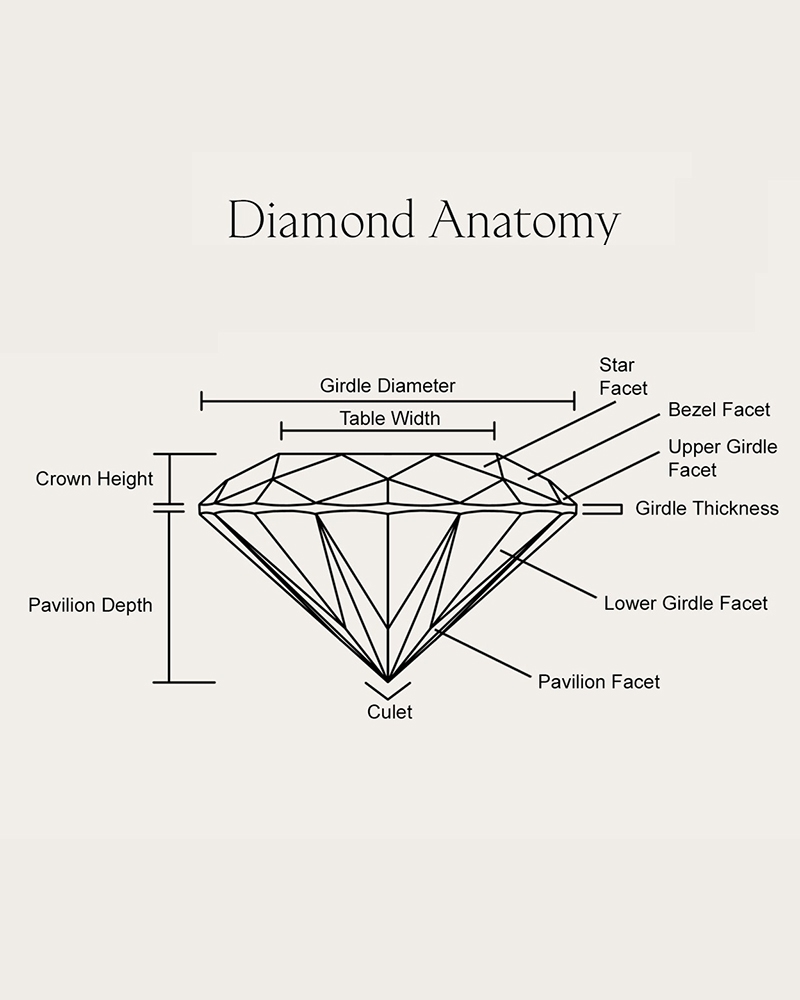
Diamond Anatomy
Facets play a very important part in creating a diamond’s sparkle (scintillation), fire and brilliance. A facet is the flat surface of a diamond or gemstone that allows it to absorb and reflect light. Although every diamond is unique, they all have the same sections, comprised of several types of facets:
Table: this is the top horizontal facet of the diamond and is the largest facet.
Crown: the angled area that surrounds the table. It directs the light as it enters and leaves the stone.
Bezel facet: also known as upper girdle facets, these are the kite-shaped facets that sit on the girdle.
Star facet: these helps gather and spread-out light to produce brilliance, fire, and scintillation.
Girdle or setting edge: this is the middle portion of the diamond at its widest point. It should be medium or slightly thick.
Diameter: sometimes called the girdle diameter, this is the total width of the diamond at its widest point.
Pavilion: this is the lower part of a diamond, from the bottom edge of the girdle to the culet.
Culet: the culet is the small, pointed tip at the very bottom of a diamond, usually where the pavilion ends.
Diamond Cut and Sparkle
A diamond isn’t just “sparkly” - those who work with diamonds split the sparkle into three main categories to describe it. These are: dispersion/fire, brilliance and scintillation, and they all contribute to a diamond’s beauty and uniqueness. Here we explain what they mean:
Dispersion/fire: Dispersion, or fire, refers to the way white light hits the different facets and suddenly splits into flashes of every colour of the rainbow, as it enters and leaves the stone.
Brilliance: Brilliance describes the brightness of a diamond and how much white light is bounced off its facets. The more striking the flashes, the more brilliant - and breathtakingly beautiful - the diamond.
Scintillation: Scintillation is the way the light plays and dances off a diamond’s facets when it is moved. A well-cut diamond will emit light from every single angle to produce the most beautiful sparkle.
Diamond Cut Grading
In the 1940s Robert M. Shipley, the founder of the GIA (Gemmological Institute of America), created the 4 Cs, originally to help his students remember the four factors that distinguish a diamond’s quality. His successor, Richard T. Liddicoat, then developed the GIA colour and clarity scales and these, together with the 4 Cs, are now the universally accepted method for evaluating any diamond’s quality across the globe. The GIA, the most prestigious of the grading authorities assesses diamonds on a sliding scale of Excellent to Poor. The IGI (International Gemmological Institute) another highly regarded grading body, uses a scale of Ideal to Poor. Both institutes grade Natural and Lab Grown diamonds.
The GIA is exceptionally regarded as the foremost authority in grading natural diamonds, whilst the IGI is held in the highest regard for Lab Grown Diamonds.
You can buy both natural and lab-grown diamonds from Diamonds & Co, and our diamond jewellery has set colour and clarity descriptions.